

Cornell AI Healthcare Leadership Program

Get Your Brochure
Overview
Leadership in today’s healthcare ecosystem requires the ability to reimagine care models, execute strategy through AI-enabled systems, and lead effectively across complex clinical, operational, and stakeholder contexts. The Cornell AI Healthcare Leadership Program is designed to equip senior healthcare leaders with the strategic judgment, execution capability, and leadership presence needed to navigate ongoing disruption and system-level change.
Structured around a Reimagine-Execute-Lead learning journey, the program examines how AI is shaping decision-making, care delivery, governance, and performance at scale, while strengthening leaders’ ability to translate strategy into sustained organizational impact. Delivered by award-winning Cornell University faculty, the program combines academic rigor with real-world relevance.
Start Date
19 September 2026
Duration
6 months
Fee
USD 5,400
Program Highlights
- 16 interactive sessions (100% LIVE)

- Access to 2000+ eCornell Courses

- Exclusive curated track - AI, decision making and negotiations in healthcare

- Certificate from Cornell University

- Peer coaching and feedback

- Regular assessments and leaderboard

Curriculum
Self-Leadership in an AI-Enabled Healthcare Environment
Effective leadership starts with self-awareness and the ability to navigate interactions with clarity and intent, particularly as healthcare organizations adopt AI-enabled systems. This session focuses on elevating emotional and social intelligence as core self-leadership capabilities. Through assessments and practical frameworks, participants will examine their emotional predispositions, strengthen self-management, and deepen awareness of how their behavior is experienced by others, particularly in moments of difference
- Assess emotional and social intelligence patterns that shape leadership impact.
- Strengthen self-awareness and self-management in day-to-day leadership.
- Improve the ability to build trust and engage constructively across differences.
Reimagining Innovation in an AI-Enabled Healthcare System
In complex healthcare systems, innovation must be anchored in a clear view of how AI is reshaping future care, capabilities, and value creation, and then worked back into today’s strategic choices. This session invites leaders to define a compelling future state for innovation in an AIenabled health ecosystem and translate it into practical, executable priorities. Emphasis is placed on clarity of ownership, sequencing, and measurement to ensure innovation moves from intent to execution
- Define a future-back innovation direction aligned to the organization’s mission, values, and ecosystem realities.
- Translate long-term innovation intent into near-term priorities with clear owners, milestones, and resource commitments.
- Establish mechanisms to track progress, course-correct, and communicate outcomes over time.
Digital Health, AI, and the Future of Care Model
Digital health and AI can be catalysts for fundamentally rethinking how care is designed, delivered, and financed. This session examines how emerging technologies are reshaping care models by enabling new ways to create value for patients, clinicians, and health systems, rather than optimizing existing processes. Leaders will focus on making deliberate strategic choices about where digital and AI truly change the economics, experience, and outcomes of care and where they do not.
- Understand how digital health and AI enable new care models, not just incremental efficiency gains.
- Identify high-impact use cases where AI changes clinical, operational, or economic logic.
- Evaluate trade-offs between competing care models in a technology-enabled ecosystem.
- Make informed strategic choices about scaling digital and AI initiatives responsibly and sustainably.
Resilience and Endurance in Healthcare
Healthcare leaders operate under sustained pressure, high stakes, and emotional intensity. This session positions resilience as a leadership capability that extends beyond individual coping to shaping how work gets done under pressure. Leaders will examine how emotional dynamics influence judgment in high-stakes environments and explore practical, evidence-based approaches to stabilizing performance and maintaining endurance over prolonged periods of complexity.
- Diagnose sources of emotional strain that affect team judgment and performance.
- Shift from individual resilience to building collective endurance.
- Inspire teams with steadiness and clarity during prolonged periods of pressure.
Strategic Data-Driven Decision Making
The quality of decisions depends on how effectively leaders use data under conditions of uncertainty. This session focuses on building a disciplined, repeatable approach to decisionmaking that integrates data, context, and human judgment to support both operational and strategic choices. Leaders will explore how to identify what truly matters in a decision, account for cognitive and organizational biases, and use data with a clear understanding of its limits.
- Apply a structured approach to making high-quality decisions in complex, data-rich environments.
- Use data effectively while recognizing cognitive biases and information limitations.
- Strengthen decision execution through clear accountability and follow-through.
Self-Leadership in an AI-Enabled Healthcare Environment
Effective leadership starts with self-awareness and the ability to navigate interactions with clarity and intent, particularly as healthcare organizations adopt AI-enabled systems. This session focuses on elevating emotional and social intelligence as core self-leadership capabilities. Through assessments and practical frameworks, participants will examine their emotional predispositions, strengthen self-management, and deepen awareness of how their behavior is experienced by others, particularly in moments of difference
- Assess emotional and social intelligence patterns that shape leadership impact.
- Strengthen self-awareness and self-management in day-to-day leadership.
- Improve the ability to build trust and engage constructively across differences.
Reimagining Innovation in an AI-Enabled Healthcare System
In complex healthcare systems, innovation must be anchored in a clear view of how AI is reshaping future care, capabilities, and value creation, and then worked back into today’s strategic choices. This session invites leaders to define a compelling future state for innovation in an AIenabled health ecosystem and translate it into practical, executable priorities. Emphasis is placed on clarity of ownership, sequencing, and measurement to ensure innovation moves from intent to execution
- Define a future-back innovation direction aligned to the organization’s mission, values, and ecosystem realities.
- Translate long-term innovation intent into near-term priorities with clear owners, milestones, and resource commitments.
- Establish mechanisms to track progress, course-correct, and communicate outcomes over time.
Digital Health, AI, and the Future of Care Model
Digital health and AI can be catalysts for fundamentally rethinking how care is designed, delivered, and financed. This session examines how emerging technologies are reshaping care models by enabling new ways to create value for patients, clinicians, and health systems, rather than optimizing existing processes. Leaders will focus on making deliberate strategic choices about where digital and AI truly change the economics, experience, and outcomes of care and where they do not.
- Understand how digital health and AI enable new care models, not just incremental efficiency gains.
- Identify high-impact use cases where AI changes clinical, operational, or economic logic.
- Evaluate trade-offs between competing care models in a technology-enabled ecosystem.
- Make informed strategic choices about scaling digital and AI initiatives responsibly and sustainably.
Resilience and Endurance in Healthcare
Healthcare leaders operate under sustained pressure, high stakes, and emotional intensity. This session positions resilience as a leadership capability that extends beyond individual coping to shaping how work gets done under pressure. Leaders will examine how emotional dynamics influence judgment in high-stakes environments and explore practical, evidence-based approaches to stabilizing performance and maintaining endurance over prolonged periods of complexity.
- Diagnose sources of emotional strain that affect team judgment and performance.
- Shift from individual resilience to building collective endurance.
- Inspire teams with steadiness and clarity during prolonged periods of pressure.
Strategic Data-Driven Decision Making
The quality of decisions depends on how effectively leaders use data under conditions of uncertainty. This session focuses on building a disciplined, repeatable approach to decisionmaking that integrates data, context, and human judgment to support both operational and strategic choices. Leaders will explore how to identify what truly matters in a decision, account for cognitive and organizational biases, and use data with a clear understanding of its limits.
- Apply a structured approach to making high-quality decisions in complex, data-rich environments.
- Use data effectively while recognizing cognitive biases and information limitations.
- Strengthen decision execution through clear accountability and follow-through.
Designing AI-Enabled Digital Healthcare Tools
Artificial intelligence is influenced by various human factors. This session will delve into the human elements that affect the design, implementation, and evaluation of tools in the healthcare industry. Leaders will examine how to apply user-centered and participatory design theory to potential solutions in healthcare, including the FAVES principles: fairness, appropriateness, validity, effectiveness, and safety.
- Explore and apply human factors related to digital health.
- Apply design theory to AI solutions in healthcare.
- Evaluate usability and acceptability in digital health.
Integrating AI-Enabled Digital Tools and Clinical Innovation
The challenge for healthcare leaders lies in integrating new tools into clinical practice in ways that enhance decision-making, improve care delivery, and gain clinician trust without disrupting safety or outcomes. This session focuses on how leaders can translate well-designed AI solutions into meaningful and sustainable clinical innovation.
- Bridge AI-enabled digital tools with real-world clinical workflows and decision-making.
- Enable adoption by aligning digital innovation with clinical priorities and professional judgment.
- Move to sustained clinical impact through thoughtful integration.
AI in Healthcare: Decision Support, Workflow, and Risk Management
As AI-enabled tools are integrated into clinical workflows, leaders must address how these systems reshape judgment, accountability, and risk. This session examines AI as decision support embedded in real workflows, not as clinical authority. Leaders will explore how AI influences judgment, accountability, and workflow design, and how to govern its use responsibly to ensure safe, effective, and defensible implementation.
- Understand AI as clinical and operational decision support.
- Distinguish workflow redesign from tool layering.
- Evaluate AI adoption through clinical, economic, and risk lenses.
Financial and Operational Drivers of System Performance
Sustained leadership performance in healthcare systems depends on the ability to manage the financial and operational forces that shape outcomes, capacity, and long-term viability. This session examines the core financial and operational drivers that determine system performance across healthcare organizations.
- Understand the key financial and operational levers that drive system-level performance.
- Evaluate trade-offs between cost, capacity, efficiency, and quality.
- Make more informed operational decisions that support sustainable performance.
Elevating Governance in Healthcare
For healthcare leaders, governance is about setting the structures and oversight mechanisms that ensure regulatory requirements are met while enabling quality, innovation, and system performance. This session examines how healthcare governance shapes the way organizations interpret regulatory requirements, allocate accountability, and manage risk. The focus is on making informed governance choices that balance regulatory discipline with operational and strategic priorities.
- Understand the role of governance in managing regulatory risk and accountability.
- Clarify oversight mechanisms in regulated healthcare systems.
- Balance compliance requirements with innovation and performance objectives.
Building High-Performing Collaborative Teams
Adaptation and responsiveness are key elements in the success for a healthcare organization today. As turnaround times shorten and demands increase, healthcare organizations must leverage teams to reach strategic goals and fulfill initiatives. In this session, leaders will diagnose team needs, set expectations for development, and build team autonomy to support leaders in embracing a more strategic focus.
- Diagnose team skill sets and develop a plan to build synergy and collaboration.
- Determine team expectations and goals.
- Implement healthy team behaviors and functioning and facilitate team development
Strategic Partnerships and Policy Dynamics in Healthcare
Healthcare strategy is increasingly shaped by policy decisions and partnerships. This session examines the interaction between healthcare policy and strategic partnerships and explores how policy signals shape partnership choices, how governance and risk are structured across public and private collaborations, and how leaders can position their organizations to create value within shifting policy environments.
- Interpret policy dynamics and their implications for partnership strategy.
- Assess partnership structures across public, private, and ecosystem actors.
- Design partnerships that align incentives, governance, and long-term sustainability.
Strategic Influence Across Healthcare Stakeholders
Progress in healthcare often depends on influencing outcomes across stakeholders with differing priorities, power, and accountability. Leaders must operate beyond formal authority to shape decisions, mobilize support, and enable coordinated action across organizational and system boundaries. This session focuses on building strategic influence across the healthcare ecosystem. The emphasis is on influencing decisions and enabling execution through credibility, clarity, and strategic communication.
- Map stakeholder interests, influence, and decision pathways.
- Build alignment across competing priorities and perspectives.
- Exercise influence to move decisions into action across boundaries.
Transforming Organizational Culture in Healthcare
Healthcare delivery continues to be in a state of constant change and as a result, today's healthcare leaders must transform the way their organizations respond to and lead change initiatives. In this session, leaders will “reset” their thinking around how best to understand, measure, implement, and lead successful change initiatives.
- Assess and diagnose your existing organizational culture, vision, and shared values.
- Determine your ideal state/culture to create a business strategy consistent with the organization's core vision and values.
- Cultivate new ideas and behaviors to move from your current culture to the ideal culture.
- Measure, track, and communicate the results of your change initiatives.
Leading Your Healthcare Organization through Change and Uncertainty
The healthcare system is continuously in flux and requires adaptability from those working in the industry. Healthcare leaders need to make their organizations efficient and safe; while improving quality as job number one. This unique balance of priorities requires healthcare leaders to ensure that everyone across the organization is in support of and working towards achieving new initiatives that will secure organization's competitiveness into the future. In this session, leaders will learn how to prepare the organization for change at the individual, departmental, and organizational level by focusing on communication and the development of a change management plan.
- Identify the precursors to change in the healthcare industry.
- Identify whether changes are at the individual, departmental, organizational , or industry level.
- Develop a change management plan to successfully carry out a change initiative.
- Know when and how to communicate changes to your employees in order to get maximum buy-in.
Leading with Gravitas under Pressure
Gravitas and executive presence are the hallmarks of leaders who inspire trust, hold attention, and influence outcomes across all levels of an organization. In this session, leaders will explore how consistent behaviors, clear messaging, and authentic leadership presence contribute to stronger relationships and greater organizational impact.
- Project confidence, credibility, and decisiveness, even in moments of uncertainty.
- Use purposeful and clear communication during high pressure situations.
- Tailor messages to inspire, influence, and align diverse internal and external stakeholders.
Please note that in the event of a global or regional catastrophe, or any unforeseen circumstances, the program's schedule, delivery method, faculty, and associated elements are subject to change at the sole discretion of the university.
Faculty

Sunita Sah
Faculty Director
Read More

Nick Fabrizio
Associate Teaching Professor
Read More

Karan Girotra
Professor of Operations Technology and Innovation
Read More

Clarence Lee
Adjunct Professor
Read More

Robert Bloomfield
Nicholas H. Noyes Professor of Management
Read More
Certificate
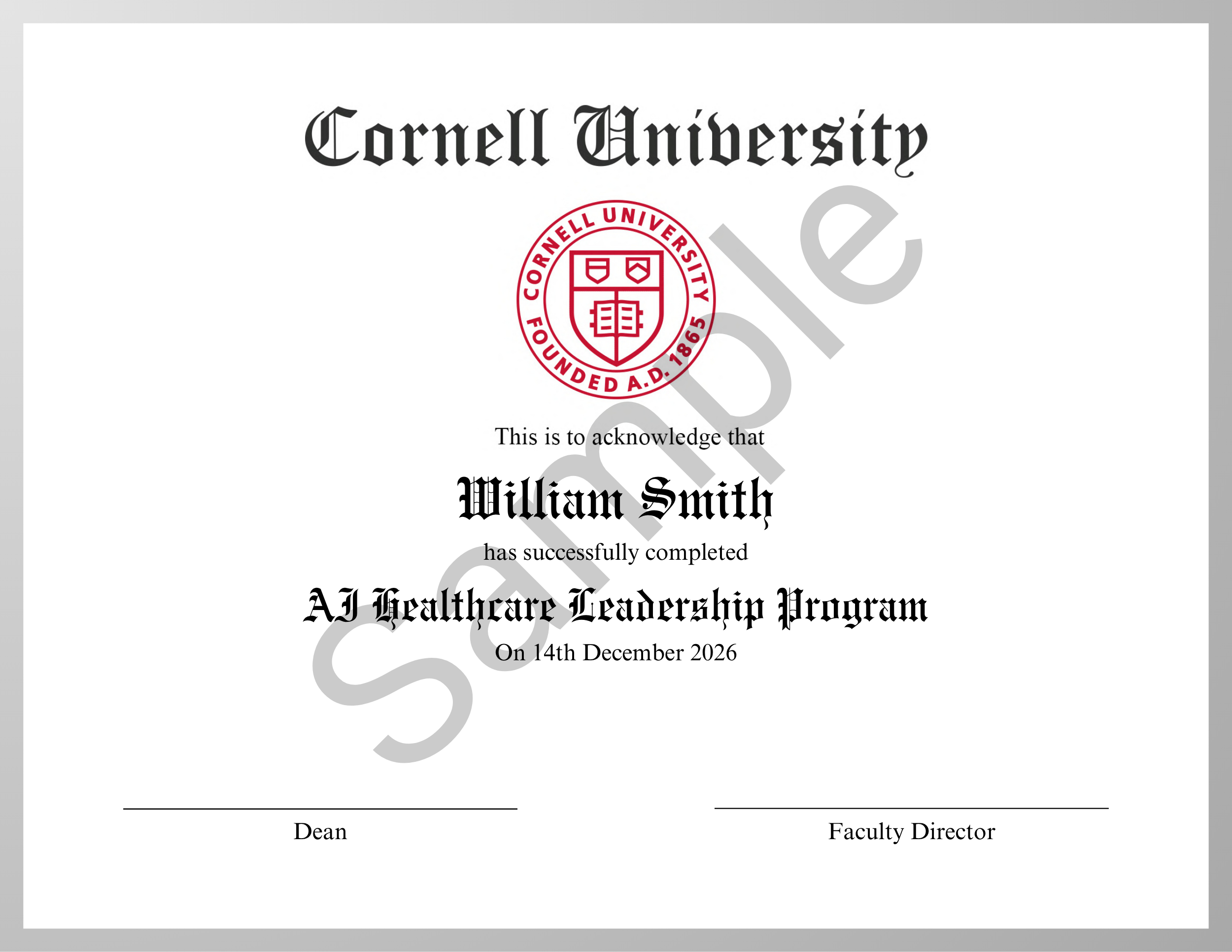
Upon successful completion of the program, participants will be awarded a digitally verifiable certificate by Cornell University
Note: Certificate image is for illustrative purposes only and may be subject to change at the discretion of Cornell University.
Who Should Apply
The Cornell Healthcare Leadership Program caters to senior executives and leaders from diverse geographies and functional roles across the healthcare ecosystem, aiming to elevate leadership capability in a rapidly evolving healthcare landscape.
The program is designed for:
Senior leaders across the healthcare ecosystem, including care delivery systems, insurance and payer organizations, life sciences and medical devices, and healthcare technology and innovation firms
Leaders accountable for translating strategy into impact across complex healthcare systems
Prerequisites
10+ years of professional experience with demonstrated success in leading high-performing teams or impactful initiatives
Bachelor’s degree or higher